
Catering and Food Service Contractor Market Size & Trends
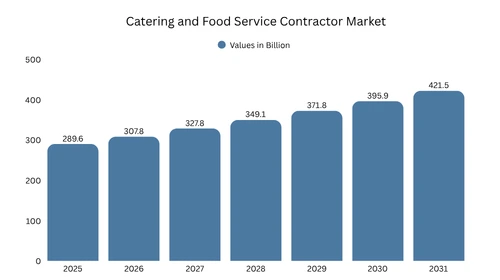
According to Zeal Market Research, the global catering and food service contractor market size was valued at USD 289.6 billion in 2025 and is projected to grow from USD 307.8 billion in 2026 to reach USD 421.5 billion by 2031, registering a CAGR of 6.5% during the forecast period (2026-2031). This market growth is driven by the increasing outsourcing of institutional food operations, rising demand for workforce nutrition programs, expansion of healthcare and educational catering services, and growing emphasis on operational efficiency across corporate, industrial, and government facilities. The catering and food service contractor market is further supported by the rising adoption of digital kitchen management systems, AI-based meal forecasting technologies, and sustainability-focused food waste reduction initiatives.
Key Market Insights
- North America accounted for the leading regional share of the global catering and food service contractor market at 34.8% in 2025, supported by strong outsourcing penetration across healthcare, education, and corporate sectors.
- By service type, contract catering services led the market in 2025 with 41.3% of global revenue, equivalent to approximately USD 119.6 billion, driven by long-term institutional outsourcing agreements.
- By end-use industry, the healthcare and senior care segment remained the dominant category owing to increasing patient meal requirements, aging populations, and rising focus on nutrition-centric care.
- By delivery model, integrated facility management catering services are expected to witness robust expansion as organizations increasingly prefer bundled outsourcing solutions.
- The industrial and remote workforce segment is projected to record the fastest growth, supported by infrastructure projects, mining operations, renewable energy sites, and large-scale construction developments.
What are the growth opportunities in the catering and food service contractor market?
Expansion Across Emerging Institutional Infrastructure
One of the most significant growth opportunities lies in the rapid expansion of institutional infrastructure across emerging economies. Increasing investments in hospitals, universities, industrial parks, airports, and smart city developments are creating long-term demand for outsourced catering and food service management. Regions such as Southeast Asia, the Middle East, and Africa are witnessing strong growth in integrated facility services, creating opportunities for large-scale catering contractors with multi-site operational capabilities.
Public-private partnerships in healthcare and education infrastructure are further accelerating outsourcing adoption, particularly in high-density urban centers where institutions increasingly prefer specialized contractors to manage large-scale food operations, compliance systems, and workforce dining logistics.
AI-Driven Food Waste Optimization
Another major opportunity area is the deployment of AI-powered food waste monitoring and predictive meal planning systems. Institutional catering providers are increasingly adopting computer vision technologies, smart inventory platforms, and consumption analytics to reduce food waste and improve procurement efficiency. Organizations are also seeking catering partners capable of supporting ESG reporting and sustainability targets through measurable waste reduction programs.
Advanced analytics platforms are also enabling contractors to optimize ingredient purchasing, reduce overproduction costs, improve menu engineering, and strengthen profitability across high-volume institutional dining operations.
Remote Workforce and Camp Catering Services
The growing number of mining projects, renewable energy installations, offshore facilities, and infrastructure developments is creating demand for advanced remote-site catering services. Contractors capable of operating modular kitchens, digital cold-chain systems, and workforce nutrition programs in isolated environments are positioned to capture high-value long-term contracts.
Increasing investments in lithium mining, semiconductor manufacturing, oil and gas exploration, and renewable energy infrastructure are particularly expanding demand for scalable workforce accommodation and integrated food service ecosystems in geographically remote regions.
Workforce Wellness and Performance Nutrition Programs
Institutional clients are increasingly integrating food services into broader employee wellness and productivity strategies. Catering contractors are therefore expanding into performance-oriented meal planning that supports hydration, fatigue management, cognitive performance, and shift-based nutritional requirements. This trend is particularly relevant across manufacturing plants, logistics hubs, healthcare facilities, and technology campuses.
Employers are also emphasizing personalized meal programs, allergen-aware menus, low-sodium diets, plant-based alternatives, and immunity-supportive nutrition solutions as part of broader occupational health and employee retention initiatives.
Evolution of Institutional Food Service Ecosystems
Catering and food service contracting can therefore be defined as a highly integrated operational service industry focused on outsourced meal preparation, nutrition management, facility dining operations, and institutional food logistics. The catering and food service contractor market operates across healthcare, education, corporate, industrial, defense, hospitality, and government sectors, spanning global facility management firms, specialized catering providers, and regional contract food service operators.
The industry is increasingly evolving toward digitally connected service ecosystems integrating procurement automation, kitchen intelligence systems, sustainability reporting, workforce wellness analytics, and centralized operational management platforms.
Catering and Food Service Contractor Market Trends
- AI-powered meal forecasting and predictive feeding systems: Contractors are increasingly adopting AI-driven analytics platforms that use attendance data, consumption patterns, and operational schedules to optimize meal production and reduce waste across institutional dining facilities. These systems are helping improve procurement planning, labor allocation, and inventory utilization in large-scale food operations.
- Sustainability and food waste accountability: Organizations are demanding measurable sustainability outcomes from catering providers, leading to increased adoption of waste monitoring systems, circular food programs, and sustainable procurement practices. Contractors are also incorporating locally sourced ingredients, reusable packaging systems, and carbon footprint tracking into operational strategies.
- Performance nutrition and workforce wellness: Catering providers are shifting toward nutrition-focused meal programs designed to support employee productivity, fatigue reduction, hydration management, and occupational health goals. High-protein meals, functional beverages, and personalized dietary planning are becoming increasingly common in institutional dining programs.
- Digital kitchen and compliance management: Food service contractors are integrating IoT-enabled kitchen systems, digital HACCP monitoring, allergen tracking tools, and automated compliance reporting platforms to improve operational consistency. Real-time temperature monitoring and cloud-based food safety documentation are becoming standard across multi-site operations.
- Integrated facility management expansion: Clients increasingly prefer bundled outsourcing contracts combining catering, housekeeping, facility management, and workplace support services under unified operational frameworks. This trend is driving consolidation among large service providers with diversified operational capabilities.
- Growth of remote and industrial catering: Rising investments in mining, renewable energy, infrastructure, and industrial construction projects are increasing demand for scalable remote-site food service operations. Contractors are deploying modular kitchens, mobile food units, and advanced cold-chain systems to support geographically isolated workforce environments.
- Plant-based and alternative protein integration: Institutional clients are increasingly requesting plant-forward menus and alternative protein options to align with sustainability targets, dietary diversity, and evolving consumer preferences. Catering contractors are responding through expanded vegan, vegetarian, and flexitarian meal offerings.
- Smart vending and autonomous dining systems: Automated meal dispensing systems, cashier-less cafeterias, and smart vending technologies are gaining traction across corporate offices, hospitals, and transportation hubs to improve operational efficiency and reduce labor dependency.
Segmental Insights
By Service Type
Based on service type, the catering and food service contractor industry is segmented into contract catering, concession catering, event catering, and integrated facility catering services. The contract catering segment led the catering and food service contractor industry in 2025, accounting for 41.3% of global revenue, equivalent to approximately USD 119.6 billion, due to long-term institutional outsourcing agreements and recurring operational demand.
- Contract Catering: Includes outsourced meal services for corporate offices, hospitals, schools, universities, industrial facilities, and government institutions. Long-term agreements and operational scalability make this the leading segment globally. Multi-year contracts also provide predictable revenue streams and operational stability for service providers.
- Concession Catering: Covers food service operations at airports, stadiums, transportation hubs, entertainment venues, and public facilities. Demand is strongly influenced by passenger traffic and event attendance levels. Digital ordering systems and grab-and-go concepts are increasingly shaping this segment.
- Event Catering: Includes catering services for conferences, exhibitions, weddings, sports events, and corporate gatherings. Customization, premium offerings, and flexible menu solutions are key competitive factors. Demand for experiential dining and themed food concepts is also rising across premium events.
- Integrated Facility Catering Services: Combines food service operations with facility management solutions such as housekeeping, maintenance, and workplace support services. This segment is witnessing strong growth due to increasing outsourcing consolidation. Large enterprises increasingly prefer single-vendor integrated operational models to improve efficiency and reduce administrative complexity.
By End-Use Industry
Based on end-use industry, the global catering and food service contractor market share is segmented into healthcare and senior care, corporate offices, education institutions, industrial and remote sites, and others, with healthcare and senior care dominating due to rising patient nutrition requirements and aging demographics.
- Healthcare and Senior Care: The leading segment is driven by rising hospital admissions, aging populations, and increasing emphasis on therapeutic nutrition and patient recovery support. Specialized dietary management and strict food safety compliance remain critical operational priorities.
- Corporate Offices: Includes employee cafeterias, executive dining, and workplace wellness food programs. Hybrid work models are driving greater demand for flexible meal planning systems. Premium workplace dining is increasingly used as a talent retention and employee engagement strategy.
- Education Institutions: Covers schools, universities, and student housing facilities requiring large-scale meal operations with nutritional compliance standards. Increasing focus on healthy student diets and allergen management is supporting operational modernization.
- Industrial and Remote Sites: Includes mining camps, oil and gas facilities, infrastructure projects, and renewable energy sites where workforce feeding logistics are operationally critical. Long-duration workforce deployments are increasing the demand for high-capacity catering infrastructure.
- Others: Includes defense establishments, correctional facilities, transportation hubs, and public institutions. These environments require highly regulated food operations with strong supply chain reliability and security protocols.
By Delivery Model
Based on delivery model, the market is segmented into on-site catering, centralized kitchen catering, mobile and remote catering, and hybrid service models, with on-site catering maintaining the largest market share.
- On-site Catering: Meals are prepared and served directly within institutional facilities, ensuring operational flexibility, freshness, and customized meal planning. This model remains highly preferred in healthcare and corporate environments requiring real-time menu adjustments.
- Centralized Kitchen Catering: Uses centralized production hubs to serve multiple facilities efficiently while optimizing procurement and labor costs. Standardized production processes help improve consistency and operational scalability.
- Mobile and Remote Catering: Designed for temporary infrastructure projects, remote industrial locations, and emergency response operations requiring flexible deployment capabilities. Portable kitchen systems and advanced cold-chain logistics are critical success factors.
- Hybrid Service Models: Combines centralized production with localized finishing kitchens and digital delivery coordination systems. Hybrid models are increasingly adopted in large urban institutions seeking both efficiency and customization.
By Client Type
Based on client type, the market for catering and food service contractor is segmented into public sector clients, private enterprises, healthcare organizations, and educational institutions, with private enterprises accounting for a major market share.
- Public Sector Clients: Includes government offices, defense establishments, transportation infrastructure, and public institutions requiring regulated large-scale catering operations. Procurement transparency and compliance standards strongly influence contract awards.
- Private Enterprises: Represent corporate campuses, industrial facilities, and commercial workplaces increasingly outsourcing food operations for efficiency and workforce satisfaction. Employers are increasingly integrating catering services into workplace experience strategies.
- Healthcare Organizations: Includes hospitals, rehabilitation centers, and long-term care facilities with specialized dietary and compliance requirements. Nutrition-driven patient care programs continue to support segment growth.
- Educational Institutions: Covers schools, colleges, universities, and residential campuses requiring high-volume institutional food services. Rising focus on student wellness and sustainable dining practices is accelerating operational upgrades across the segment.
| By Service Type | By End-Use Industry | By Delivery Model | By Client Type |
|---|---|---|---|
|
|
|
|
Regional Insights
North America
North America accounted for 34.8% of the global catering and food service contractor market share in 2025, making it the largest regional market.
- The United States dominates due to strong outsourcing penetration across healthcare, education, and corporate sectors.
- Large institutional infrastructure, mature facility management ecosystems, and rising workforce wellness initiatives continue to support catering and food service contractor market growth.
- Canada shows stable growth supported by healthcare expansion and increasing demand for sustainable food service operations.
- Technology integration, AI-enabled kitchen management, and ESG-focused procurement frameworks are accelerating operational modernization across the region.
Europe
Europe catering and food service contractor market was valued at USD 82.4 billion in 2025 and is expected to grow steadily through 2031.
- Countries such as the UK, Germany, and France are witnessing increasing demand for sustainable institutional catering services.
- Food waste reduction regulations and ESG-focused procurement policies are major market growth drivers.
- Integrated facility management outsourcing remains highly developed across the region.
- Plant-based menu adoption, ethical sourcing practices, and carbon reduction targets are significantly influencing institutional food procurement strategies.
Asia Pacific
The Asia Pacific region is among the fastest-growing markets globally.
- China and India are key growth markets driven by rapid industrialization, infrastructure investments, and healthcare expansion.
- Large-scale smart city projects and industrial parks are increasing the demand for outsourced food operations.
- Japan and Australia represent mature markets with advanced institutional food safety and operational standards.
- Expanding manufacturing activity, urban workforce growth, and rising healthcare infrastructure investments continue to strengthen regional demand for institutional catering services.
LATAM
Latin America and the Middle East are emerging as high-potential markets.
- Brazil and Mexico are witnessing growing adoption of outsourced catering services across healthcare and industrial sectors.
- In the Middle East, infrastructure development, tourism expansion, and large-scale workforce accommodation projects are supporting demand for contract food services.
- Mining operations, energy projects, and government-backed industrial developments are further increasing demand for remote workforce catering capabilities.
Company Market Share
- The top 5 players: Compass Group, Sodexo, Aramark, Elior Group, and ISS Facility Services collectively accounted for approximately 49% of global catering and food service contractor revenue in 2025, reflecting a moderately consolidated market structure.
- Large multinational operators leverage integrated procurement systems, digital kitchen technologies, and global facility management capabilities to maintain a competitive advantage.
- Long-term institutional contracts and bundled facility management services remain key revenue retention strategies.
- Regional and niche operators are gaining traction by focusing on healthcare nutrition, remote-site catering, sustainability-focused services, and customized workforce wellness programs.
Top Companies in the Catering and Food Service Contractor Industry
- Compass Group
- Sodexo
- Aramark
- Elior Group
- ISS Facility Services
- Delaware North
- Gategroup
- DO & CO AG
- Thompson Hospitality
- OCS Group
- Mitie Group
- BaxterStorey
- NTUC Foodfare
- Neo Group
- CulinArt Group
- Compass Group continues to dominate through its large-scale institutional catering network, digital operational capabilities, and sustainability-focused food service strategies.
- Sodexo maintains a strong market position through integrated facility management offerings, healthcare nutrition expertise, and workplace wellness programs.
- Aramark emphasizes operational efficiency, AI-enabled kitchen management, and customized institutional food solutions across education and healthcare sectors.
- Elior Group is expanding its sustainability and responsible sourcing initiatives while strengthening digital meal management capabilities.
Recent Developments in the Catering and Food Service Contractor Market:
- In January 2026, Compass Group announced the expansion of its AI-driven food-waste reduction initiatives across institutional dining operations to support sustainability targets and operational efficiency.
- In September 2025, Sodexo expanded its workforce wellness catering programs across healthcare and corporate facilities, focusing on nutrition-driven meal planning and sustainable sourcing practices.
Frequently Asked Questions
How big is the global catering and food service contractor market?
According to analysis by Zeal Market Research, the global catering and food service contractor market was valued at USD 289.6 billion in 2025 and is projected to increase from USD 307.8 billion in 2026 to reach USD 421.5 billion by 2031, registering a CAGR of 6.5% during the forecast period (2026-2031).
What is driving growth in the global market?
Growth is being driven by increasing institutional outsourcing, expansion of healthcare and industrial infrastructure, rising demand for workforce wellness programs, sustainability-focused food operations, and adoption of digital catering management systems.
Which services are most popular in the global market?
Popular services include contract catering, healthcare nutrition services, corporate cafeteria management, remote-site catering, concession catering, and integrated facility food management solutions.
Which regions are leading the global market?
North America leads the market due to high outsourcing penetration and mature institutional infrastructure, while Asia-Pacific is witnessing rapid growth supported by industrialization and healthcare expansion.
Who are the leading players in the catering and food service contractor market?
Leading companies operating in the catering and food service contractor market include Compass Group, Sodexo, Aramark, Elior Group, ISS Facility Services, Delaware North, and Gategroup.