
Horseback Trekking Tourism Market Size
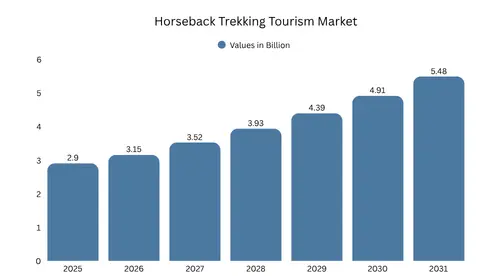
According to Zeal Market Research, the global horseback trekking tourism market size was valued at USD 2.9 billion in 2025 and is projected to grow from USD 3.15 billion in 2026 to reach USD 5.48 billion by 2031, registering a CAGR of 11.7% during the forecast period (2026-2031). The horseback trekking tourism market growth is driven by rising demand for slow tourism experiences, increasing interest in outdoor adventure travel, and growing consumer preference for nature-based wellness activities. Expansion of equestrian trail infrastructure, rural tourism initiatives, and experiential travel trends are further supporting the growth of the horseback trekking tourism market globally.
Key Market Insights
- North America accounted for the leading regional share of the global horseback trekking tourism market at 34.8% in 2025, supported by extensive trail networks, ranch tourism, and a strong outdoor recreation culture.
- By trek type, the multi-day expedition segment led the market in 2025 with 41.2% of global revenue, equivalent to approximately USD 1.1 billion, driven by rising demand for immersive wilderness experiences.
- By traveler type, international tourists accounted for the largest market share, driven by rising demand for destination-based equestrian adventure tourism in regions such as Patagonia, Mongolia, Iceland, and the American West.
- By booking channel, online booking platforms are expected to witness the fastest growth as travelers increasingly rely on digital travel marketplaces, social media discovery, and direct operator websites.
- The women traveler segment is projected to record the fastest growth during the forecast period, supported by increasing participation in wellness-focused and solo adventure travel experiences.
What are the growth opportunities in the Horseback Trekking Tourism Market?
Expansion of Rural and Regenerative Tourism
One of the most prominent growth opportunities lies in expanding rural and regenerative tourism models. Governments and tourism authorities are increasingly investing in remote tourism corridors, equestrian trails, ranch stays, and conservation tourism programs to stimulate local economies. Horseback trekking tourism enables distributed tourism spending across villages, ranchlands, mountain communities, and protected landscapes while supporting sustainable land-use practices.
The market is also benefiting from the increasing use of horseback trekking as a tool for rural diversification, particularly in regions experiencing agricultural decline or population migration toward urban centers. Local communities are increasingly developing tourism ecosystems around horse breeding, countryside lodging, traditional food experiences, and guided wilderness expeditions. This creates additional revenue streams for landowners, indigenous communities, and small tourism operators while preserving cultural landscapes and traditional equestrian practices.
Furthermore, regenerative tourism models are encouraging operators to integrate low-impact trail management, biodiversity conservation, rotational grazing systems, and habitat restoration initiatives into tourism packages. This is creating opportunities for premium eco-tourism positioning, particularly among environmentally conscious travelers seeking authentic and sustainability-oriented adventure experiences.
Growth of Wellness and Digital Detox Tourism
Another significant opportunity area is the growing overlap between horseback trekking and wellness tourism. Consumers increasingly seek low-stimulation, screen-free, and emotionally restorative travel experiences. Horseback trekking operators are integrating mindfulness sessions, forest immersion, equine-assisted wellness activities, and slow-travel itineraries to attract travelers seeking mental wellness and stress recovery experiences.
The emotional and psychological benefits associated with horseback interaction are also contributing to horseback trekking tourism industry expansion. Horses are increasingly incorporated into wellness-focused retreats centered on stress reduction, emotional resilience, mindfulness, and personal development. Multi-day horseback expeditions are being marketed as transformative travel experiences that combine physical activity, nature immersion, and mental restoration.
Luxury wellness resorts and eco-retreat operators are additionally incorporating horseback trekking into broader wellness ecosystems that include yoga, meditation, spa therapies, nutrition-focused hospitality, and holistic health programs. This convergence is allowing horseback trekking tourism providers to access higher-value traveler segments and premium pricing opportunities.
Development of Cultural and Heritage-Based Riding Expeditions
Cultural immersion tourism presents another high-potential opportunity for market participants. Travelers increasingly seek authentic equestrian experiences tied to indigenous traditions, nomadic lifestyles, ranching heritage, and pastoral communities. Destinations offering Mongolian horse culture, Patagonian gaucho experiences, cowboy ranch tourism, and Central Asian riding expeditions are witnessing increasing international interest.
Operators are increasingly designing tourism packages that combine horseback trekking with local storytelling, traditional horsemanship demonstrations, regional cuisine, folk music, and participation in seasonal cultural activities. This enables destinations to position horseback trekking as a heritage tourism product rather than purely an outdoor recreation activity.
Growing traveler interest in experiential and educational tourism is further supporting demand for guided expeditions that provide historical context, indigenous knowledge, and exposure to traditional livestock management systems. Such experiences are particularly attractive to long-haul international travelers seeking culturally differentiated tourism products unavailable in mainstream travel markets.
Digitization of Adventure Travel Booking Ecosystems
Online platforms and social media-driven travel discovery are transforming the horseback trekking tourism industry. Tour operators are increasingly leveraging digital storytelling, influencer marketing, virtual route previews, and direct-to-consumer booking models to reach younger adventure travelers. Personalized itinerary customization and niche expedition packages are further improving customer engagement and conversion rates.
Travel discovery through visual platforms such as Instagram, YouTube, and travel-focused content channels is significantly increasing awareness of horseback trekking destinations among younger demographics. Cinematic wilderness content, remote landscapes, and authentic riding experiences are becoming highly marketable tourism assets capable of generating strong organic engagement.
Digital booking ecosystems are also improving operational efficiency through automated itinerary management, multilingual booking systems, online rider assessments, and real-time communication tools. Smaller operators in remote regions are increasingly able to access international customers directly without depending heavily on traditional travel intermediaries.
In addition, the rise of personalized tourism algorithms and AI-driven travel recommendations is enabling operators to target highly specific traveler preferences such as solo female travel, luxury wilderness expeditions, eco-tourism experiences, or beginner-friendly horseback adventures.
Evolution of Horseback Trekking as a Premium Experiential Tourism Category
Horseback trekking tourism can therefore be defined as a specialized experiential tourism segment combining adventure travel, nature immersion, cultural exploration, and wellness-driven outdoor recreation. The market horseback trekking tourism spans luxury ranch tourism, wilderness expeditions, eco-tourism operators, cultural riding experiences, and guided adventure travel providers across both developed and emerging tourism destinations.
The market is increasingly transitioning from a niche recreational activity into a premium adventure tourism category capable of attracting high-spending international travelers. Luxury operators are introducing private guided expeditions, high-end eco-lodges, gourmet culinary experiences, customized itineraries, and destination-exclusive horseback routes to differentiate their offerings.
Growing consumer willingness to pay for unique and emotionally engaging travel experiences is supporting premiumization across the market. Operators emphasizing exclusivity, sustainability, personalized service, and authentic cultural integration are increasingly able to command higher pricing structures compared to conventional outdoor tourism activities.
Additionally, the integration of horseback trekking into broader experiential travel categories such as wildlife tourism, photography tourism, conservation tourism, and wellness retreats is expanding the market beyond traditional equestrian enthusiasts toward mainstream experiential travelers.
Horseback Trekking Tourism Market Trends
- Rise of slow tourism and digital detox travel: Travelers are increasingly prioritizing remote, low-density, and nature-focused tourism experiences that encourage disconnection from urban lifestyles and digital devices. Horseback trekking naturally aligns with this slow-travel movement. Multi-day riding expeditions provide extended immersion in wilderness environments while limiting exposure to mass tourism infrastructure. This trend is particularly strong among urban professionals, wellness travelers, and younger consumers seeking emotionally restorative travel experiences.
- Expansion of equestrian trail infrastructure: Governments and recreation authorities are investing in horse-friendly campgrounds, trail restoration projects, rural tourism corridors, and equestrian-access public lands to support sustainable outdoor tourism development. Cross-border trail systems, protected wilderness routes, and countryside riding networks are expanding tourism accessibility in remote regions. Infrastructure development is also enabling operators to offer safer and longer-duration expeditions.
- Growth of wellness-integrated trekking experiences: Operators are combining horseback trekking with meditation, mindfulness, yoga retreats, equine-assisted therapy, and wellness-focused itineraries to differentiate tourism offerings. Wellness tourism integration is increasing in demand among travelers seeking stress reduction, emotional balance, and mental health-focused travel experiences. Equine-assisted interaction is increasingly positioned as a therapeutic and mindfulness-oriented activity within premium tourism packages.
- Increasing popularity of cultural immersion expeditions: Travelers increasingly seek authentic riding experiences connected to local heritage, indigenous horse traditions, cattle ranching culture, and nomadic lifestyles. Tourism operators are integrating horseback trekking with traditional accommodation, regional cuisine, folk storytelling, livestock management activities, and cultural festivals to create highly differentiated tourism experiences.
- Women-led and solo female adventure tourism: Female participation in horseback trekking tourism is rising significantly, leading operators to design safer, wellness-oriented, and community-focused expedition packages. Women-focused horseback retreats, guided group adventures, and transformational travel programs are becoming increasingly common. Operators are also emphasizing emotional safety, small-group travel, and supportive travel communities to attract solo female travelers.
- Sustainability and conservation-focused tourism models: Eco-conscious travelers are increasingly supporting operators that emphasize ethical horse treatment, regenerative tourism, habitat preservation, and low-impact wilderness exploration. Sustainable trail management, reduced environmental footprint, and community-based tourism practices are becoming key competitive differentiators within the industry.
- Luxury wilderness tourism and premium expedition growth: High-income travelers are increasingly seeking exclusive horseback trekking experiences that combine remote wilderness access with luxury accommodations, private guides, gourmet dining, and personalized itineraries. Premium horseback tourism is expanding across destinations such as Patagonia, Iceland, Mongolia, and the American West.
- Integration of horseback trekking with wildlife and eco-tourism: Operators are increasingly combining horseback expeditions with wildlife observation, birdwatching, photography tourism, and protected-area exploration. Horses are often viewed as a lower-impact alternative to motorized safaris and off-road tourism activities, particularly in ecologically sensitive environments.
Horseback Trekking Tourism Market Segmental Insights
By Trek Type
Based on trek type, the horseback trekking tourism industry is segmented into day rides, multi-day expeditions, ranch-based trekking, and cultural riding tours. The multi-day expedition segment led the market in 2025, accounting for 41.2% of global revenue, equivalent to approximately USD 1.1 billion, due to rising demand for immersive adventure travel and wilderness exploration experiences.
- Day rides: Includes short-duration guided horseback excursions typically offered near tourism hubs, resorts, national parks, and recreational destinations. These experiences appeal to beginner riders and casual tourists. Day rides are particularly popular within family tourism, resort tourism, and domestic recreational travel markets due to lower pricing and minimal riding experience requirements.
- Multi-day expeditions: Comprise extended wilderness treks involving camping, mountain crossings, remote trail systems, and destination-based adventure experiences. This segment generates the highest tourism spending per traveler. Demand is driven by travelers seeking off-grid experiences, physical adventure, cultural immersion, and premium wilderness tourism packages.
- Ranch-based trekking: Includes horseback experiences integrated with ranch stays, cowboy tourism, cattle-driving activities, and countryside hospitality experiences. Ranch tourism is gaining popularity due to increasing consumer interest in rural lifestyles, agricultural tourism, and authentic countryside experiences.
- Cultural riding tours: Cover heritage-focused riding experiences linked to indigenous traditions, nomadic communities, gaucho tourism, and equestrian cultural immersion activities. These tours increasingly attract international travelers seeking educational, heritage-based, and experiential tourism experiences.
By Traveler Type
Based on traveler type, the global market share is segmented into domestic tourists, international tourists, solo travelers, and group travelers, with international tourists dominating the market due to high demand for destination-based adventure tourism experiences.
- Domestic tourists: Includes travelers participating in local and regional horseback trekking activities within their home countries, often linked to weekend tourism and outdoor recreation. Domestic demand is supported by increasing interest in countryside tourism, staycations, and short-duration adventure experiences.
- International tourists: Represent the leading segment driven by cross-border adventure tourism demand and destination-specific equestrian experiences. Long-haul travelers are increasingly attracted to globally recognized horseback trekking destinations offering unique landscapes and strong cultural identity.
- Solo travelers: Increasingly important due to rising interest in transformational travel, wellness tourism, and self-guided adventure experiences. Operators are responding through women-focused riding programs, guided solo expeditions, and community-based travel experiences.
- Group travelers: Includes family groups, organized tour participants, and corporate adventure tourism packages. Group tourism remains important for educational tourism, recreational travel clubs, and guided wilderness expeditions.
By Booking Channel
Based on booking channel, the market is segmented into online booking platforms, travel agencies, direct operator booking, and others, with online booking platforms emerging as the fastest-growing segment.
- Online booking platforms: Driven by digital travel marketplaces, social media marketing, mobile travel applications, and direct-to-consumer booking ecosystems. Travelers increasingly rely on online reviews, immersive visual content, and instant booking capabilities when selecting horseback trekking experiences.
- Travel agencies: Continue to play an important role in premium adventure travel packages and international tourism coordination. Agencies are particularly important for complex multi-country itineraries, luxury tourism packages, and high-value experiential travel planning.
- Direct operator booking: Allows operators to improve profit margins and strengthen personalized customer engagement. Many operators are investing in multilingual websites, digital payment systems, and customized itinerary development to improve direct bookings.
- Others: Includes tourism boards, hotel partnerships, destination management companies, and local tourism coordinators supporting regional tourism integration and packaged travel experiences.
By End User
Based on end user, the market is segmented into men, women, and family travelers, with the women segment recording the fastest growth rate.
- Men: Continue to represent a significant market share due to strong participation in outdoor adventure tourism and wilderness expeditions. Male travelers show strong interest in physically demanding riding routes, mountain expeditions, and remote exploration experiences.
- Women: The fastest-growing segment, driven by increasing participation in solo travel, wellness tourism, and experiential adventure activities. Women travelers are increasingly attracted to horseback trekking experiences focused on emotional wellness, cultural immersion, safety, and community-oriented travel.
- Family travelers: Includes family-oriented ranch vacations, beginner-friendly riding experiences, and countryside tourism packages. Educational farm stays, wildlife interaction, and child-friendly riding programs are supporting family segment growth.
| By Trek Type | By Traveler Type | By Booking Channel | By End User |
|---|---|---|---|
|
|
|
|
Regional Insights
North America
North America accounted for 34.8% of the global horseback trekking tourism market share in 2025, making it the leading regional market.
- The United States dominates due to extensive equestrian trails, national parks, ranch tourism, and strong outdoor recreation participation.
- States such as Montana, Wyoming, Colorado, Arizona, and Texas represent major horseback trekking destinations supported by wilderness tourism and ranch culture.
- Canada shows strong market growth supported by wilderness tourism, mountain trekking destinations, and eco-tourism expansion.
- Growing interest in wellness tourism, experiential travel, and sustainable outdoor recreation continues to support regional demand.
- Advanced tourism infrastructure, high adventure tourism spending, and increasing demand for premium wilderness experiences are further strengthening regional market leadership.
Europe
Europe horseback trekking tourism industry was valued at USD 0.8 billion in 2025 and is expected to grow steadily through 2031.
- Iceland, Spain, France, and the UK are key destinations for equestrian adventure tourism and countryside riding experiences.
- Countries across Southern and Eastern Europe are increasingly promoting rural tourism and heritage-based equestrian travel to diversify tourism economies.
- Sustainable tourism development, landscape preservation, and heritage conservation are major market drivers across the region.
- Demand for luxury countryside tourism, wellness retreats, and eco-conscious travel experiences continues to expand.
- European travelers increasingly favor slow tourism experiences, multi-day countryside expeditions, and nature-based travel formats with lower environmental impact.
Asia Pacific
The Asia Pacific region is among the fastest-growing markets globally.
- Mongolia, India, Australia, and New Zealand are emerging as major horseback trekking destinations due to their unique landscapes and strong equestrian tourism potential.
- Cultural tourism, nomadic heritage experiences, and eco-tourism development are driving regional growth.
- Government investments in rural tourism infrastructure and adventure tourism development are further supporting market expansion.
- Mongolia continues to attract strong international interest due to its nomadic horse culture and large-scale wilderness trekking opportunities.
- Australia and New Zealand benefit from well-developed adventure tourism industries and increasing demand for premium horseback wilderness experiences.
- Growing middle-class tourism spending and rising interest in outdoor recreation across Asia are creating long-term regional growth opportunities.
LATAM
Latin America and the Middle East are emerging as high-potential markets.
- Argentina and Chile are witnessing increasing demand for Patagonian horseback expeditions and gaucho tourism experiences.
- Brazil and Mexico are gradually expanding ranch tourism and eco-adventure travel offerings to attract international travelers.
- In the Middle East, luxury desert horseback experiences and heritage tourism initiatives are supporting niche market development.
- Remote landscapes, cultural authenticity, and lower tourism saturation levels make these regions increasingly attractive for premium experiential tourism.
- Government-backed tourism diversification initiatives and eco-tourism investments are expected to improve long-term regional market potential.
Horseback Trekking Tourism Market Share
- The global horseback trekking tourism market share remains moderately fragmented, with regional tour operators, ranch tourism providers, eco-tourism companies, and luxury adventure travel firms competing across niche tourism segments.
- Premium operators differentiate through exclusive trekking routes, cultural immersion experiences, luxury accommodations, and sustainability-focused tourism models.
- Digital marketing, online booking systems, and influencer-driven travel promotion are increasingly shaping competitive positioning.
- Operators emphasizing ethical horse treatment, conservation tourism, and wellness integration are gaining stronger consumer preference.
Top Companies in the Horseback Trekking Tourism Industry
- Equitours
- Hidden Trails
- Riding Worldwide
- Unicorn Trails
- In The Saddle
- SaddleTravel
- Horseback Riding Holidays
- Wild Women Expeditions
- Frontiers North Adventures
- Andean Trails
- Rancho Los Banos
- Pure Exploration
- Mountain Travel Sobek
- Adventure Life
- Equestrian Escapes
Horseback Trekking Tourism Industry News:
- In March 2026, the Maharashtra Tourism Department announced the launch of the “Koyna Daulat Dongri Festival 2026” in Satara in collaboration with regional tourism authorities. The event includes horseback riding, eco-tourism activities, rural tourism promotion, wellness tourism experiences, and adventure sports aimed at strengthening countryside and horseback tourism across the region.
- In February 2026, the Government of India announced major investments in sustainable trekking and adventure tourism infrastructure under Union Budget 2026–27. The initiative includes development of ecologically sustainable mountain trails across Himachal Pradesh, Uttarakhand, Jammu & Kashmir, the Eastern Ghats, and Western Ghats, creating long-term growth opportunities for horseback trekking and wilderness tourism operators.
Frequently Asked Questions
How big is the global horseback trekking tourism market?
The global horseback trekking tourism market was valued at USD 2.9 billion in 2025 and is projected to increase from USD 3.15 billion in 2026 to reach USD 5.48 billion by 2031, registering a CAGR of 11.7% during the forecast period (2026-2031).
What is driving growth in the global market?
Growth is driven by rising interest in adventure tourism, increasing demand for slow travel experiences, expansion of wellness-focused tourism, growth of eco-tourism activities, and increasing investment in equestrian trail infrastructure and rural tourism development.
Which services are most popular in the global market?
Popular services include multi-day horseback expeditions, ranch-based riding experiences, cultural horseback tours, wilderness trail trekking, guided countryside rides, and luxury equestrian adventure packages.
Which regions are leading the global market?
North America leads the market due to extensive equestrian infrastructure and strong outdoor recreation culture, while Europe and Asia Pacific are witnessing rapid growth supported by eco-tourism, rural tourism, and cultural adventure travel demand.
Who are the leading players in the horseback trekking tourism market?
Leading companies operating in the horseback trekking tourism market include Equitours, Hidden Trails, Riding Worldwide, Unicorn Trails, In The Saddle, SaddleTravel, and Adventure Life.