
Crossfit Apparel Market Size
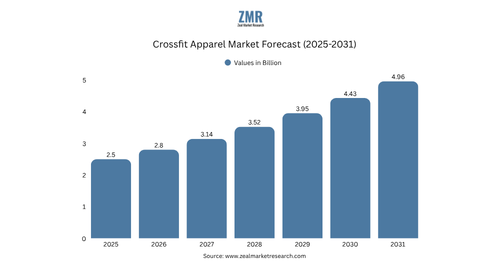
According to Zeal Market Research, the global CrossFit apparel market size was valued at USD 2.5 billion in 2025 and is projected to grow from USD 2.80 billion in 2026 to reach USD 4.96 billion by 2031, registering a CAGR of 12.1% during the forecast period (2026-2031). This growth is driven by the increasing global adoption of high-intensity functional training (HIFT), rising membership across CrossFit-affiliated gyms, and growing participation in competitive fitness events. The crossfit apparel market is further supported by the shift toward performance-centric apparel that enhances mobility, reduces injury risk, and improves thermal regulation during intense workouts.
Key Market Insights
- North America accounted for the leading regional share of the global CrossFit apparel market at 35.6% in 2025, supported by strong participation in functional fitness programs and premium activewear spending.
- By product type, the tops segment led the market in 2025 with 36.8% of global revenue, equivalent to approximately USD 0.7 billion, driven by strong demand for training t-shirts, compression wear, and sports bras.
- By material type, polyester blends remained the dominant category owing to their durability, moisture-wicking capability, and cost efficiency across both premium and mass-market apparel lines.
- By distribution channel, online retail is expected to witness robust expansion as brands continue to strengthen direct-to-consumer strategies through e-commerce, marketplaces, and digital marketing channels.
- The women segment is projected to record the fastest growth among end users, supported by rising female participation in CrossFit training and increasing availability of performance-focused product ranges.
What are the growth opportunities in the CrossFit apparel market?
Expansion Across Emerging Markets
One of the most prominent growth opportunities lies in geographic expansion across emerging markets. Regions such as Southeast Asia, Latin America, and parts of Eastern Europe are witnessing a rapid increase in CrossFit affiliates and independent functional fitness centers. This is creating demand for region-specific apparel that addresses climatic conditions such as high humidity and heat, while also serving price-sensitive consumers seeking mid-range performance products.
Advanced Performance Textile Innovation
Another significant opportunity area is the advancement of performance-enhancing textile technologies. Manufacturers are increasingly incorporating features such as anti-microbial coatings, moisture-channeling yarns, compression zoning, and thermoregulation layers. Integration with wearable technology, including embedded sensors for heart rate, muscle activation, and sweat analysis, represents a high-value innovation frontier likely to attract professional athletes and data-driven fitness users.
Direct-to-Consumer and Community-Led Sales Models
Brand-led ecosystems and direct-to-consumer strategies also present strong growth potential. Companies are building integrated fitness communities through mobile apps, online training programs, and athlete-led content, using apparel as a core engagement and monetization channel. Limited-edition product launches, affiliate gym merchandise, and event-based collections linked to competitions are generating premium-margin sales and strengthening customer loyalty.
Sustainable Product Development
Sustainability-driven product development is emerging as a long-term opportunity. Brands are investing in circular manufacturing systems, recycled fiber materials, low-impact dyeing processes, and biodegradable packaging solutions. This aligns with evolving regulatory frameworks and consumer preferences, particularly in Europe and North America, where environmental accountability increasingly influences purchase decisions.
Evolution of a Specialized Activewear Category
CrossFit apparel can therefore be defined as a technically advanced segment of activewear designed to support high-intensity, varied functional training. It operates at the intersection of performance sportswear, athleisure fashion, and digital fitness ecosystems, spanning mass-market brands, premium labels, and specialized niche manufacturers.
Crossfit Apparel Market Trends
- Material innovation and performance engineering: There is a strong shift toward engineered fabrics that combine durability with flexibility. Features such as ripstop panels, seamless knitting, targeted compression zones, and laser-cut ventilation are increasingly integrated into apparel to enhance both performance and comfort under high-stress conditions.
- Sustainability integration: Apparel brands are adopting recycled polyester, bio-based elastane alternatives, and water-efficient dyeing processes. Lifecycle transparency and certifications are becoming competitive differentiators, particularly in premium segments.
- Athleisure convergence: CrossFit apparel is increasingly designed with dual-use functionality, enabling consumers to transition seamlessly from gym environments to casual settings. This is driving demand for minimalist aesthetics, neutral tones, and versatile silhouettes.
- Female participation and product specialization: The growing share of female CrossFit participants is leading to expanded product lines with enhanced fit engineering, support systems, and inclusive sizing. Brands are also investing in maternity-friendly activewear and adaptive designs.
- Digital and connected apparel ecosystems: Integration with wearable devices and fitness apps is enabling performance tracking and personalized training insights. Apparel is becoming part of a broader digital fitness ecosystem rather than a standalone product.
- Community-driven branding and localization: Apparel brands are leveraging the strong community culture of CrossFit by offering localized merchandise, affiliate gym branding, and event-specific collections that resonate with niche audiences.
CrossFit Market Segmental Insights
By Product Type
Based on product type, the crossfit apparel industry is segmented into tops, bottoms, outerwear, and accessories. The tops segment led the market in 2025, accounting for 36.8% of global revenue, equivalent to approximately USD 0.7 billion, due to high replacement frequency and strong demand for performance-enhancing upper-body garments.
- Tops: Includes compression t-shirts, tank tops, long-sleeve training shirts, and sports bras. These products emphasize moisture management, odor control, and unrestricted movement. Frequent usage cycles lead to higher repeat purchases, making this the most revenue-generating segment.
- Bottoms: Comprises shorts, leggings, joggers, and compression tights designed for flexibility and durability. Reinforced seams, anti-slip waistbands, and squat-proof fabrics are critical features driving adoption in this segment.
- Outerwear: Includes hoodies, jackets, and training pullovers used for warm-ups, cooldowns, and outdoor training. This segment is increasingly influenced by athleisure trends and seasonal demand patterns.
- Accessories: Covers socks, gloves, headbands, knee sleeves, and gym bags. Although smaller in share, this segment plays a strategic role in brand extension and customer retention.
By Material Type
Based on material type, the global market share is segmented into polyester blends, nylon, cotton blends, and others, with synthetic materials dominating due to superior performance characteristics.
- Polyester blends: The leading segment due to excellent moisture-wicking, durability, and cost efficiency. Widely used across both premium and mass-market product lines.
- Nylon: Offers higher strength and elasticity, making it ideal for compression garments and high-performance leggings. It is commonly used in premium apparel collections.
- Cotton blends: Preferred for comfort and breathability in lower-intensity training and athleisure applications. However, limited moisture management capabilities restrict usage in high-intensity workouts.
- Others: Includes advanced materials such as spandex-rich blends, bamboo fibers, and recycled textiles, which are gaining traction due to sustainability and performance benefits.
By Distribution Channel
Based on distribution channel, the market is segmented into online retail, specialty sports stores, brand outlets, and others, with online retail emerging as the fastest-growing segment.
- Online retail: Driven by brand-owned websites, marketplaces, and social commerce platforms. Personalized recommendations, influencer marketing, and direct engagement strategies are key growth drivers.
- Specialty sports stores: Provide expert guidance and curated product selections, catering to serious athletes and fitness enthusiasts seeking high-performance gear.
- Brand outlets: Offer immersive brand experiences and exclusive product launches, supporting premium positioning and customer loyalty.
- Others: Includes department stores and gym-based retail, which cater to impulse purchases and localized demand.
By End Use
Based on end use, the market is segmented into men, women, and unisex, with the women segment recording the fastest growth rate.
- Men: Continues to hold a significant share due to high participation in strength-based training and competitive CrossFit events.
- Women: The fastest-growing segment, driven by increasing female participation, greater product availability, and targeted marketing strategies.
- Unisex: Includes versatile designs that appeal to a broad consumer base, particularly in accessories and casual apparel categories.
| By Product Type | By Material Type | By Distribution Channel | By End Use |
|---|---|---|---|
|
|
|
|
Regional Insights
North America
North America accounted for 35.6% of the global crossfit apparel market share in 2025, making it the largest regional market.
- The United States dominates due to a high concentration of CrossFit affiliates, strong consumer spending on premium activewear, and a well-established fitness culture.
- Demand is driven by technological innovation, brand collaborations, and strong participation in competitive events such as the CrossFit Games.
- Canada shows consistent growth supported by outdoor fitness trends and increasing adoption of functional training programs.
Europe
Europe crossfit apparel market was valued at USD 0.6 billion in 2025 and is expected to grow steadily through 2030.
- Countries such as the UK, Germany, and France are witnessing increased adoption of CrossFit and similar training methodologies.
- Sustainability, ethical sourcing, and product transparency are key purchasing drivers in the region.
- Premiumization trends are strong, with consumers willing to pay higher prices for performance and eco-friendly apparel.
Asia Pacific
The Asia Pacific region is among the fastest-growing markets globally.
- China and India are key growth markets, driven by urbanization, rising middle-class income, and increasing awareness of fitness and wellness.
- Australia and Japan represent mature markets with strong demand for premium and technologically advanced apparel.
- Expansion of international fitness chains and digital fitness platforms is further supporting market growth.
LATAM
Latin America and the Middle East are emerging as high-potential markets.
- Brazil and Mexico are leading markets in Latin America, supported by strong community-based fitness culture.
- In the Middle East, government initiatives promoting health and wellness, along with investments in fitness infrastructure, are driving adoption.
Crossfit Apparel Market Share
- The top 5 players: Nike, Reebok, Under Armour, Lululemon, and Rogue Fitness, collectively accounted for approximately 52% of global CrossFit apparel sales in 2025, reflecting a moderately consolidated market structure.
- Large multinational brands leverage economies of scale, global distribution networks, and advanced R&D capabilities to maintain competitive advantage.
- Direct-to-consumer channels are enabling brands to capture higher margins and build stronger customer relationships through personalized engagement.
- Niche and emerging brands are gaining traction by focusing on specialized product categories, sustainability, and strong community alignment.
Leading Companies in the Crossfit Apparel Market
Few of the prominent players operating in the CrossFit apparel market include:
- Nike
- Reebok
- Under Armour
- Lululemon Athletica
- Rogue Fitness
- Gymshark
- Adidas AG
- Puma SE
- ASRV
- NoBull
- Ten Thousand
- Virus International
- Born Primitive
- Alphalete Athletics
- 2POOD
- Nike continues to dominate through innovation in fabric technology, global athlete endorsements, and a strong direct-to-consumer strategy supported by digital platforms.
- Reebok maintains a strong legacy in the CrossFit ecosystem, leveraging its historical association with the CrossFit Games and focusing on functional training-specific product lines.
- Under Armour emphasizes performance-driven apparel with advanced moisture management, compression technologies, and durability features tailored for high-intensity training.
- Lululemon is expanding aggressively into high-performance training apparel, leveraging its premium brand positioning and innovation in technical fabrics.
Crossfit Apparel Market News:
- In February 2026, Lululemon expanded its training category with new product launches focused on high-intensity workouts, integrating enhanced flexibility and durability features into its apparel range.
- In September 2025, Nike introduced a new high-performance training apparel line incorporating advanced sweat-wicking fabrics and reinforced construction designed specifically for functional fitness athletes.
Frequently Asked Questions
How big is the global crossfit apparel market?
According to Zeal Market Research, the global crossfit apparel market was valued at USD 2.5 billion in 2025 and is projected to increase from USD 2.80 billion in 2026 to reach USD 4.96 billion by 2031, registering a CAGR of 12.1% during the forecast period (2026-2031).
What is driving growth in the global market?
Growth is being driven by increasing participation in functional fitness programs, rising gym memberships, demand for durable workout clothing, expanding athleisure adoption, and growing awareness of performance-oriented activewear.
Which products are most popular in the global market?
Popular products include compression shirts, moisture-wicking t-shirts, training shorts, leggings, sports bras, hoodies, outerwear, and supportive socks designed for high-intensity workouts.
Which regions are leading the global market?
North America leads the market due to a strong CrossFit community and high fitness spending, while Europe and Asia-Pacific are witnessing rapid growth supported by increasing gym culture.
Who are the leading players in the crossfit apparel market?
Leading companies operating in the crossfit apparel market include Nike, Reebok, Under Armour, Lululemon Athletica, Rogue Fitness, Gymshark, Adidas AG, and Puma SE.